
Why Is There Always a Queue for the Women's Toilets?
The real reason women wait in line

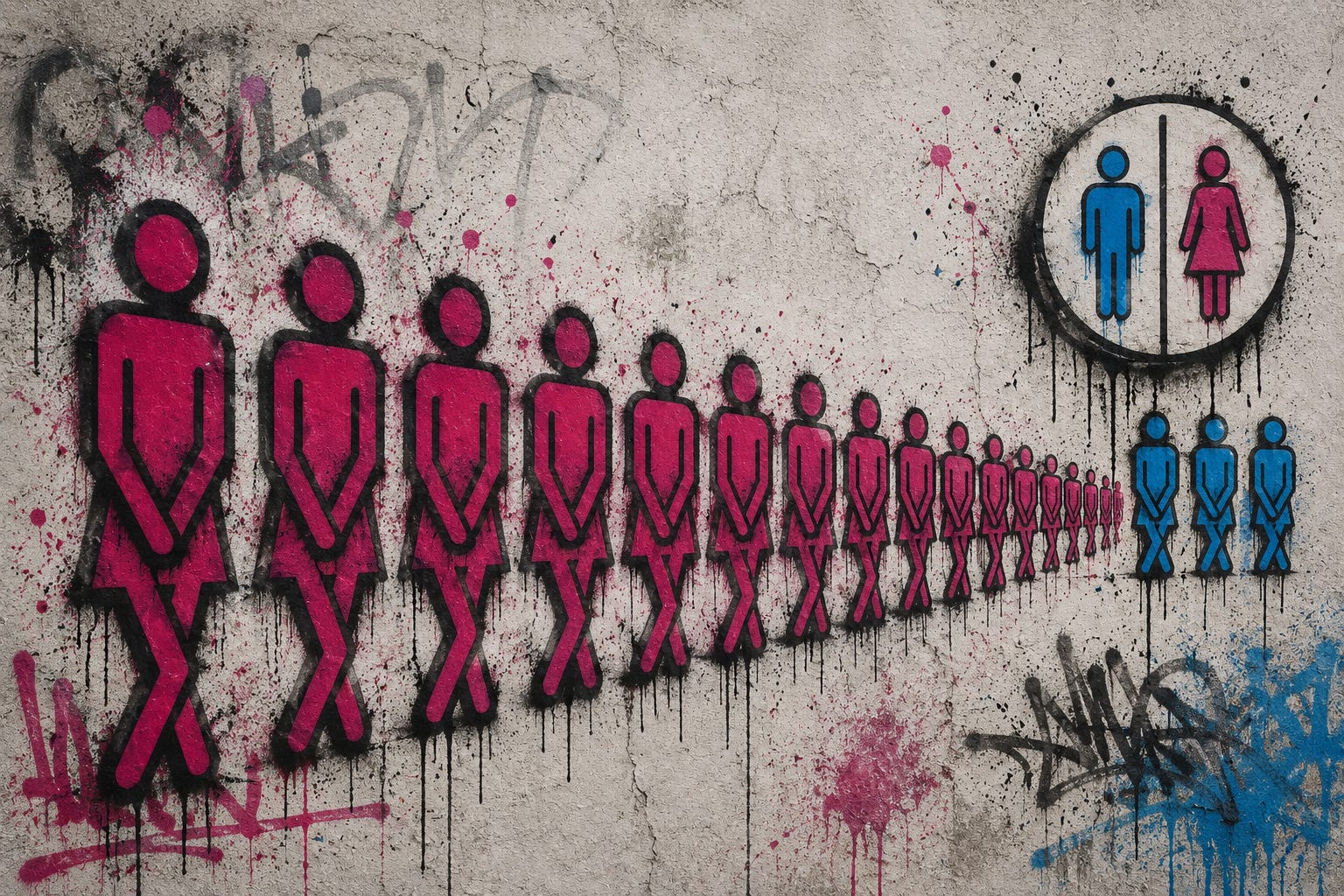
As women, we queue for the bathroom. It’s a given, right? (There is even a twitter feed dedicated to this fact.)
Actually a survey in 2018 found that 59% of women say they “very often” or “quite often” have to queue to use toilets in public places. That’s compared to just 11% of men who reported doing so.
Now although this is something that I knew, I didn’t think much about why this is the case. Not until I read Invisible Women by Caroline Criado Perez.
I sort of, well, just accepted that that was how things were.
As a woman, you stand in line.
You wait.
And wait.
And wait.
But we don’t wait in line for the fun of it. We don’t do it to moan to other women about relationships (something a bloke once told me he thought was the reason 🙄).
Nor do we wait in line because we (and the women we are waiting behind) are ‘inefficient’ at going to the toilet.
Nope. According to Perez, it’s about:
architectural gender bias
women’s physiology
and unpaid work.
1. Floor space
I am building a (hypothetical) building.
I have ‘this much’ floor space for toilets (boxes out an imaginary floor space with fingers).
I divide the floor space equally between males and females (cuts the imaginary floor space in half).
Gender equality, right?
Not quite.
Providing equal floor space in male and female public toilets may not be equal after all.
Male toilets have urinals. Which need far less floor space than cubicles.
Hence, the number of people who can relieve themselves at once is far higher in the male bathroom than in the female bathroom, per square foot of floor space.
2. Frequency
Many women need more trips to the bathroom than men. Fact!
Pregnancy reduces bladder capacity. And with over 800,000 women in the UK alone being pregnant each year. That’s a lot of bathroom breaks.
Also, women get 8 times more urinary-tract infections than men. UTIs that make you feel you need to go pee. Even when you don’t.
And the treatment?
Yup, that’s right. It’s to to pee more often.
So again, more trips to the bathroom.
3. Duration
According to Perez, women take up to 2.3 times as long as men to use the toilet. But it’s not because we’re slow or incompetent. It’s because there are other things (and people) to think about.
“Women make up the majority of the elderly and disabled, two groups that will tend to need more time in the toilet.
Women are also more likely to be accompanied by children, as well as disabled and older people.
Then there’s the 20–25% of women of childbearing age who may be on their period at any one time, and therefore needing to change a tampon or a sanitary pad.”
Hence, longer queues.
A Call for Equity for Fathers
The most logical solution is for a woman to take the child/ren to the bathroom.
Why?
Because baby-changing facilities are (almost) always in the women’s bathrooms.
But that doesn’t make it right. And it doesn’t make it fair. On women or men.
Donte Palmer brought this to light when he shared how he and other fathers change nappies in public bathrooms. Which usually included squatting and changing nappies on their knees!
Something they had to figure out, since there are no changing facilities for men to use.
Final thoughts
I’m not sure what I intended to do with this knowledge. Or why I needed to write about it.
Maybe it’s about being aware. About acknowledging that inequalities (on both sides) exist.
Or maybe it was the curious part of me asking: “Why are we waiting again?”
Whatever the reason… I like knowing shit like this.
If nothing else, I’ll have something to talk about with the woman standing next to me. While we’re queuing for the toilet!
Sources
Al-Badr, A. and Al-Shaikh, G. (2013) Recurrent Urinary Tract Infections Management in Women
Criado Perez, C. (2019). Invisible Women: Exposing Data Bias in a World Designed for Men.
Office for National Statistics (2022). Conceptions in England and Wales
yougov.co.uk. Potty Parity: would it be fairer to make women’s toilets bigger?